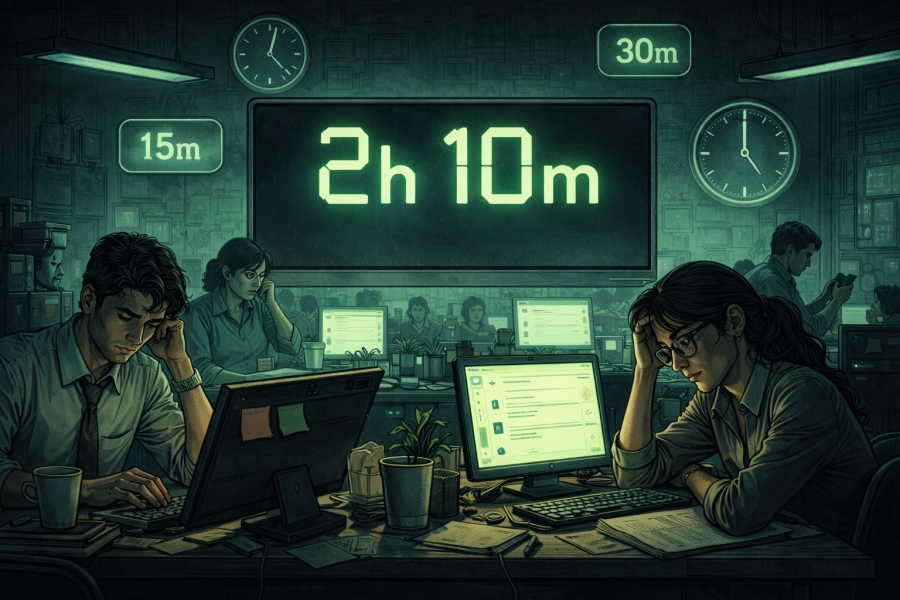



In the modern workplace, there’s an unwritten rule: if you’re online, you’re working. If you’re not — you’re probably not working enough.

In digital work, silence is no longer neutral. It’s suspicious.
When the “typing…” bubble appears in a chat, everyone knows something is happening. When it doesn’t, a quiet discomfort creeps in. Did you see the message? Are you ignoring it? Are you even there?
In that space between message and response, a new impulse is born: to write something — anything.
In a physical space, silence can signal concentration. In a digital space, it often signals absence.
That’s why people type even when they have no real message. Short replies without substance. Redundant confirmations. Repeating what’s already been said. What matters is leaving a trace of activity. Being seen as present.
Silence feels risky. A message — any message — feels like insurance.
The typing indicator has become a micro-proof of engagement. Even when half the drafted text is deleted, the act of typing serves a purpose: confirmation of participation.
In some cases, the message isn’t meant to inform. It’s meant to signal. “I’m here.” “I’m following.” “I’m on it.”
Content becomes secondary. Visibility becomes primary.
In cultures where online status is constantly exposed, communication turns into performance. We don’t just ask what we want to say — we ask how our silence will be interpreted.
That’s how messages are born that add nothing to the conversation but preserve the impression of involvement. Digital noise as a defense mechanism.
This isn’t about competence. It’s adaptation to an environment that continuously measures presence.
Every unnecessary message interrupts someone’s focus — including our own. Micro-communication accumulates. Ten insignificant messages a day become an hour of lost attention per week.
Ironically, the attempt to appear engaged often reduces actual contribution.
Perhaps the greatest luxury of modern work isn’t flexible hours. Perhaps it’s the right to silence without explanation.
Not replying immediately doesn’t mean not working. Not typing doesn’t mean not thinking.
If digital silence once again became a sign of focus rather than absence, much of the communication noise would disappear on its own.
Sometimes the most professional message is the one that is never sent.