


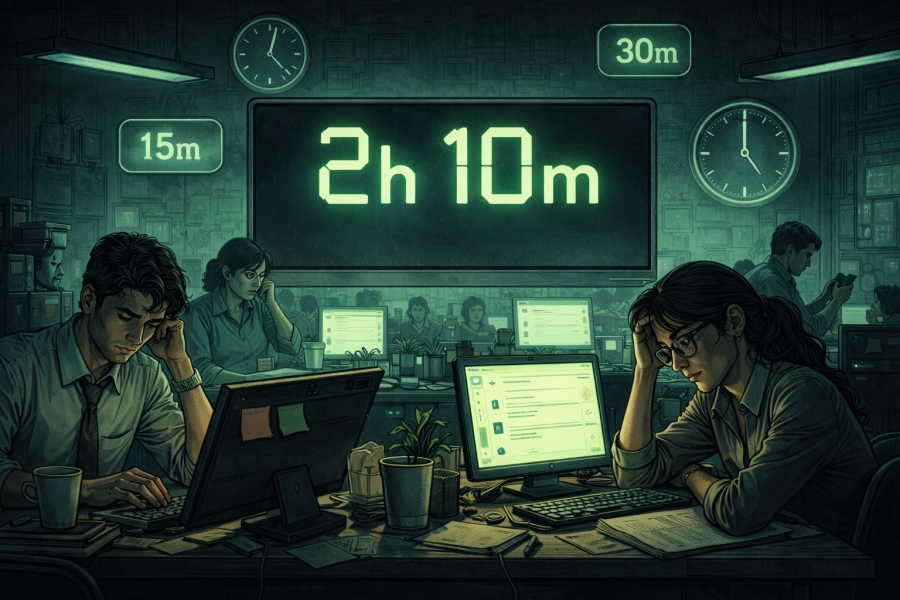
In today’s digital office, work is no longer just about completing tasks. It’s also a constant demonstration of presence.
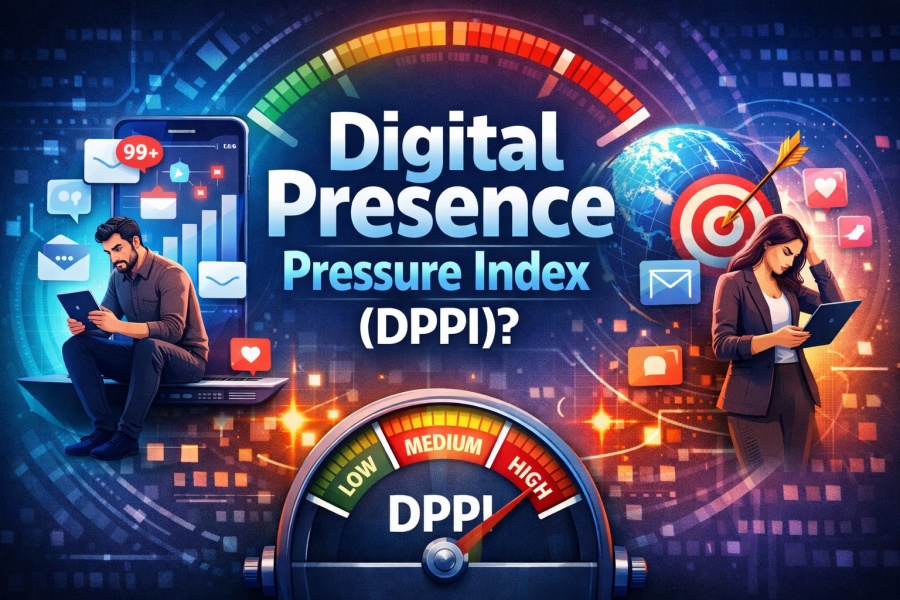
That’s where the Digital Presence Pressure Index (DPPI) comes in — a concept that measures the psychological pressure employees feel to remain constantly digitally present, regardless of actual productivity.
In other words: how much energy you spend on “looking like you’re working” instead of actually working.
Tools like Slack, Teams, and Zoom were meant to increase efficiency. And they did — at least technically.
But in parallel, they created a new dynamic:
The result? People don’t just work — they perform work.
DPPI attempts to quantify something that used to be just a “gut feeling.”
It can be broken down into several key components:
How quickly you reply to messages — and how often it interrupts you.
How often you “signal” that you’re working (statuses, messages, updates).
How many times per day your concentration is disrupted by notifications.
How often you stay online after hours — not because you have to, but because you feel like you have to.
That subtle discomfort when you’ve been offline for 30+ minutes.
If you recognize yourself in at least three of these — congratulations, your DPPI isn’t low.
On the surface, DPPI looks like a “soft” issue. A bit of stress, a bit of Slack — nothing dramatic.
But the consequences are very real:
The most dangerous part?
It all feels completely normal.
You don’t need complex analytics to get a sense of where you stand.
Ask yourself:
The more your answers lean toward “too often,” the higher your DPPI.
It’s easy to blame Slack. Or remote work. Or “this generation.”
But the real issue is deeper:
Organizations have replaced trust with visibility.
When work can’t be easily measured, people start measuring presence.
And once presence is measured, people start optimizing for it.
That’s where the spiral begins.
Here’s the uncomfortable truth: you can’t eliminate it. You can only control it.
Not everything needs to be instant. If it’s urgent — they’ll call.
No Slack. No email. No exceptions.
People track your status less when they see results.
If you’re always available, you become the standard — and the problem.
The Digital Presence Pressure Index isn’t just another buzzword.
It’s a mirror of modern work.
It shows how far we’ve drifted from a simple idea:
work is what you produce — not how often you appear online.
And as long as the green dot matters more than actual output, DPPI will keep rising.
The only question is:
will you ignore it — or start managing it?
In today’s digital office, work is no longer just about completing tasks. It’s also a constant demonstration of presence.
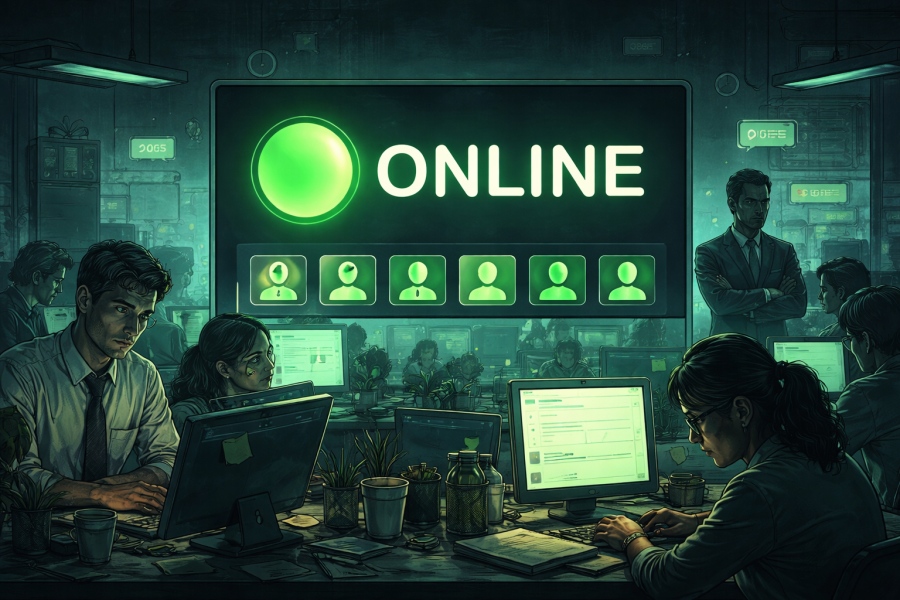
In a traditional office, the symbolism of work was clear: a desk, a chair, and a body sitting at that desk. If you were physically present, it was assumed you were working. If you weren’t, the question was why.