


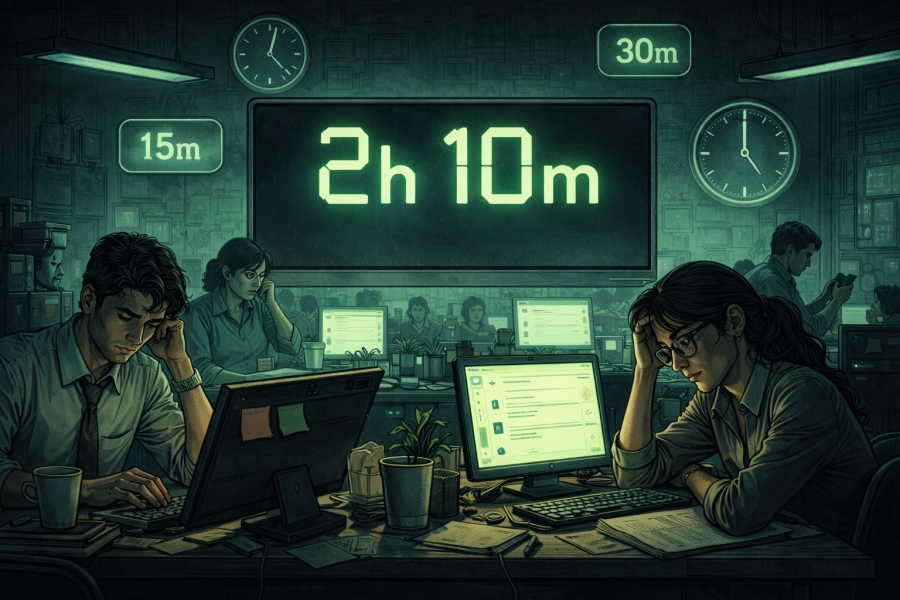
In today’s digital office, work is no longer just about completing tasks. It’s also a constant demonstration of presence.

There’s a difference between working and performing work. In today’s digital environment, that difference has become almost invisible — because what’s visible on a screen often matters more than what’s actually happening inside your head.
Here are ten of the most common micro-performances we use to maintain the illusion of busyness.
The document window is always ready. One click and Excel replaces YouTube. A reflex faster than thought.
Three sentences that say nothing, but confirm presence. The important thing is that the “typing…” bubble exists.
Read the message immediately. Reply later — so it looks like you were thinking. Digital dramaturgy.
The status must glow. Even when you’re not there, it has to look like you are.
Calendar Tetris. The more blocks, the more important you appear — regardless of the content.
Tiny movements to maintain “Active” status. The technological equivalent of nodding your head.
Entering the conversation without real necessity, but with a clear goal: to be recorded.
Colors, tags, priorities. The system looks perfect; the work stands still.
Forward it along. No context, no conclusion. Just a trace of activity.
The sound of productivity. If typing can be heard, something must be happening.
Because the system is designed to measure presence, not focus. Visibility, not depth. Activity, not meaning.
Once online status became a proxy for engagement, performance of work became a defense mechanism. We don’t pretend because we’re lazy — we pretend because it’s an adaptation to an environment that is constantly watching.
The problem is that this continuous micro-performance consumes energy. Maintaining an impression requires attention. And attention is a limited resource.
This isn’t a critique of work. It’s a critique of the theatre of work.
Remove the pressure of constant visibility, and many of these rituals would disappear on their own. What would remain is focus. And silence.
And silence, in a digital world, is the most underestimated form of productivity.
In today’s digital office, work is no longer just about completing tasks. It’s also a constant demonstration of presence.
Remote work was supposed to bring freedom. Instead, in many organizations, it introduced a new form of control — quiet, digital, and constant. In a physical office, it was enough to sit at your desk. In a remote environment, you have to glow green.