


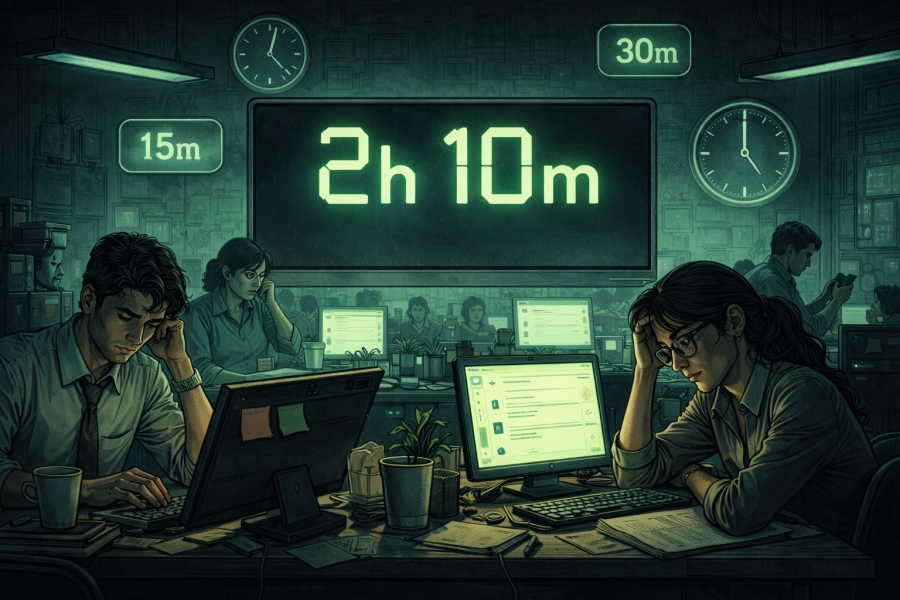
In today’s digital office, work is no longer just about completing tasks. It’s also a constant demonstration of presence.

Remote work was supposed to bring freedom. Instead, in many organizations, it introduced a new form of control — quiet, digital, and constant.
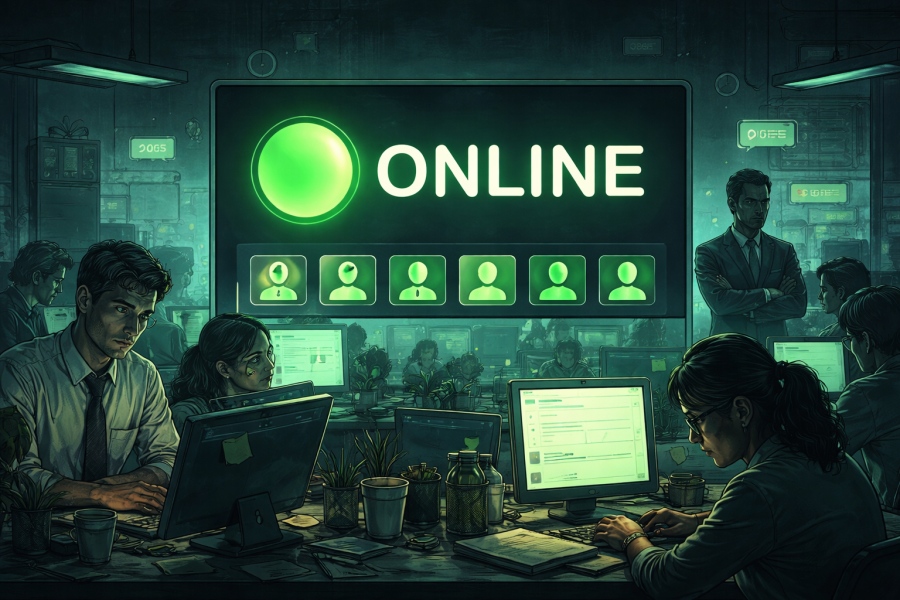
In a physical office, it was enough to sit at your desk. In a remote environment, you have to glow green.
Communication platforms have turned status into a signal of reliability. If you’re “online,” you’re available. If you’re available, you’re engaged. If you respond quickly, you’re working.
It’s simple logic. And it’s wrong.
Fast reactions don’t equal deep thinking. Continuous presence doesn’t equal progress. In reality, high-quality work often requires the opposite: silence, slowness, and the absence of notifications.
Remote work opened the door to tools that track activity — time spent online, number of messages, responsiveness, idle minutes. They’re often framed as transparency tools, but the psychological message is clear: we can see whether you’re there.
The problem isn’t the technology itself. The problem is a culture that interprets visibility as proof of work.
When employees know their status is visible, behavior adapts. Focus gets split. Part of the attention goes to the task, part to maintaining the appearance of activity.
In digital spaces, speed looks impressive. A two-minute response creates the impression of efficiency. But often, it’s just a micro-interruption in someone’s deeper work.
Fast replies create chains of fast replies. That’s how a culture of reaction replaces a culture of reflection.
Over time, such an environment favors those who are constantly available — not necessarily those who make the best decisions.
Remote work can increase concentration. It can eliminate unnecessary interruptions. It can enable autonomy.
But only if availability is not confused with effectiveness.
When online status starts being treated like a KPI, the paradox appears: people are constantly present, yet real progress stagnates. Energy is spent proving that work is happening instead of actually doing the work.
In a digital environment, productivity isn’t measured by green dots or response speed. It’s measured by clarity of priorities, quality of decisions, and the ability to finish what truly matters — even if that means being “offline” for a while.
Remote work isn’t the problem. The myth is.
Online does not mean productive.
And the sooner we admit that, the sooner we’ll stop rewarding presence and start valuing focus.
In today’s digital office, work is no longer just about completing tasks. It’s also a constant demonstration of presence.
In a traditional office, the symbolism of work was clear: a desk, a chair, and a body sitting at that desk. If you were physically present, it was assumed you were working. If you weren’t, the question was why.