


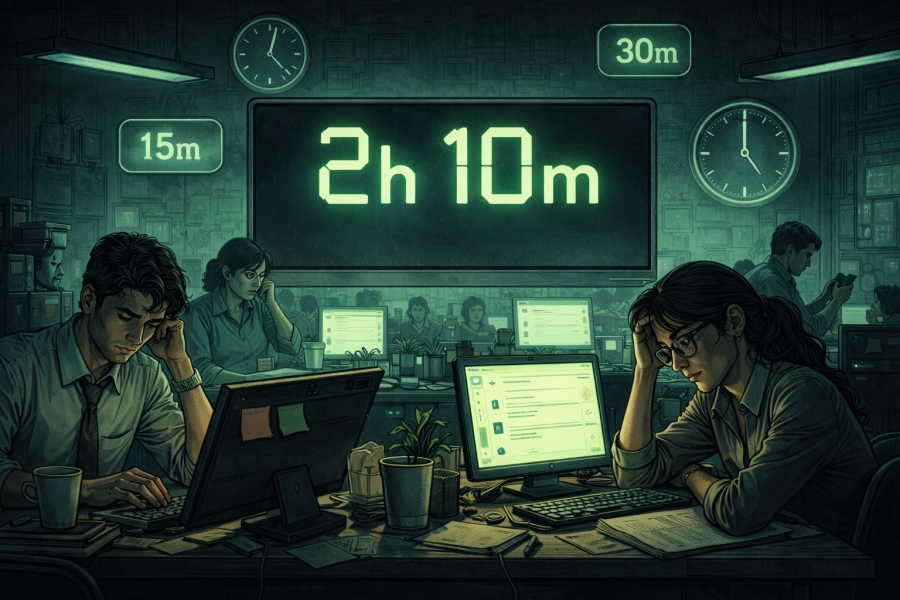
In today’s digital office, work is no longer just about completing tasks. It’s also a constant demonstration of presence.
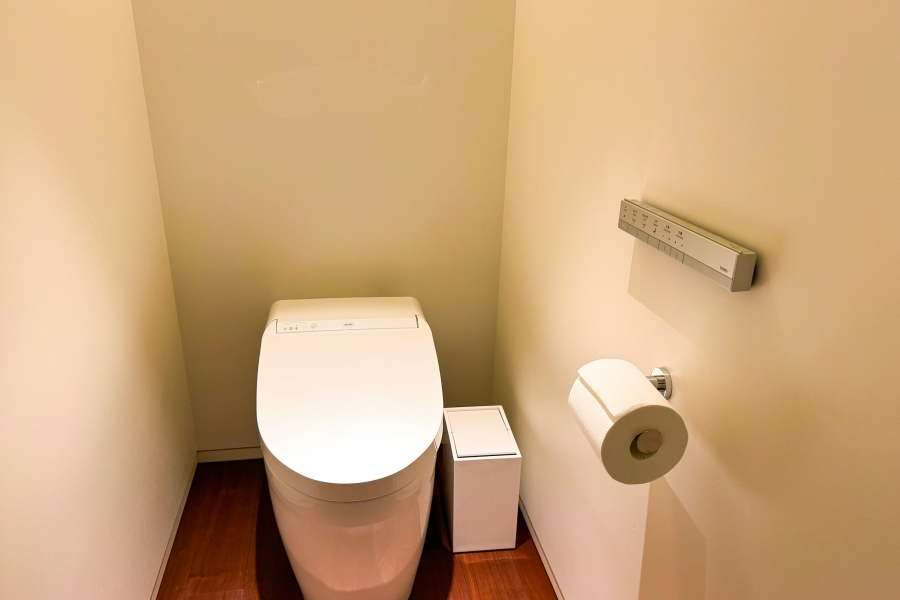
In an era of constant availability, online statuses, and notifications pulsing faster than a heartbeat, there is one place where an employee can still disappear without explanation. Not a conference room. Not a “focus block” in the calendar. Not a lunch break.
Going to the toilet has, paradoxically, become the last refuge of micro-freedom in modern office work. While Slack glows green, Teams shows you as present, and the inbox grows relentlessly, the restroom remains the one zone where no reasonable person asks, “Are you there?”
Behind this semi-ironic thesis lies a more serious question: what are those few minutes of absence actually worth — psychologically, but also financially?
To understand the “economics of a bathroom break,” let’s start with the numbers.
According to publicly available data on average earnings in Croatia, the average net salary is around €1,300 per month. Assuming a standard 40-hour workweek, or roughly 160 hours per month, the math is simple:
€1,300 / 160 hours = €8.13 per hour
That means the average employee earns approximately:
€0.135 per minute
€0.00225 per second
At first glance, insignificant. Context changes perspective.
An average “number one” takes about 3 minutes.
An average “number two” — realistically speaking — takes around 7 minutes (including that moment of silence, scrolling, and mental reset).
Applying the hourly rate:
Number one (3 minutes)
3 × €0.135 = €0.405
Number two (7 minutes)
7 × €0.135 = €0.945
In other words, during a single average “longer break,” an employee earns nearly one euro.
It’s not a fortune, but the symbolism is interesting: even when we are formally “not working,” the value of our labor continues to flow. The system keeps counting time.
Let’s assume a conservative scenario:
2 short breaks per day (2 × 3 minutes)
1 longer break per day (7 minutes)
Total: 13 minutes per day
13 minutes × €0.135 = €1.755 per day
If we work 22 business days per month:
€1.755 × 22 = €38.61 per month
On an annual basis (12 months):
€38.61 × 12 = €463.32 per year
In other words, the average employee in Croatia “earns” about €463 per year while in the bathroom.
That’s almost half of an average monthly salary — spent in the only space immune to the question: “Why are you offline?”
This calculation is not an invitation to abuse working hours. It’s a mirror of a culture where the perception of activity often matters more than actual results.
In many office environments — whether corporations, public institutions, or freelancing platforms — employees feel the pressure of constant visibility. Online status has become the digital equivalent of being physically present at your desk. Three minutes without a green dot can trigger a message: “Are you there?”
The bathroom, however, remains a legitimate explanation that no one questions. Not because it’s productive, but because it’s biologically indisputable.
In that sense, going to the toilet is not an escape from work — it’s an escape from surveillance. A short interruption of the performance of presence — what we might call the “theater of productivity.”
Numerous studies on focus and cognitive performance show that the brain does not function optimally in a continuous, uninterrupted mode. Short breaks, even just a few minutes long, help reset attention, reduce stress, and improve long-term effectiveness.
The paradox is obvious: systems that informally encourage constant availability often produce workers who simulate activity to maintain the perception of engagement. In that context, the bathroom becomes the only space where an employee can stop “looking busy.”
Phrases like “remote work monitoring,” “micromanagement,” and “always-on culture” are no longer theoretical concepts — they are everyday reality. Digital tools have enabled flexibility, but they have also opened the door to invisible surveillance and presence anxiety.
When going to the bathroom becomes a symbol of freedom, the problem is not the bathroom.
The problem is a system that measures value through a status indicator rather than through results.
A trip to the toilet may last seven minutes, but it says far more about the state of modern work. Financially, it’s a few dozen cents per break. Psychologically, it’s a space where an employee, at least briefly, stops being an activity indicator and becomes a person again.
If the bathroom is the last refuge of freedom, the real question is not how much we earn while we’re inside — but why we need it in the first place.
Because in a healthy work environment, freedom should not begin only behind a locked bathroom door.
In today’s digital office, work is no longer just about completing tasks. It’s also a constant demonstration of presence.

Remote work was supposed to bring freedom. Instead, in many organizations, it introduced a new form of control — quiet, digital, and constant. In a physical office, it was enough to sit at your desk. In a remote environment, you have to glow green.